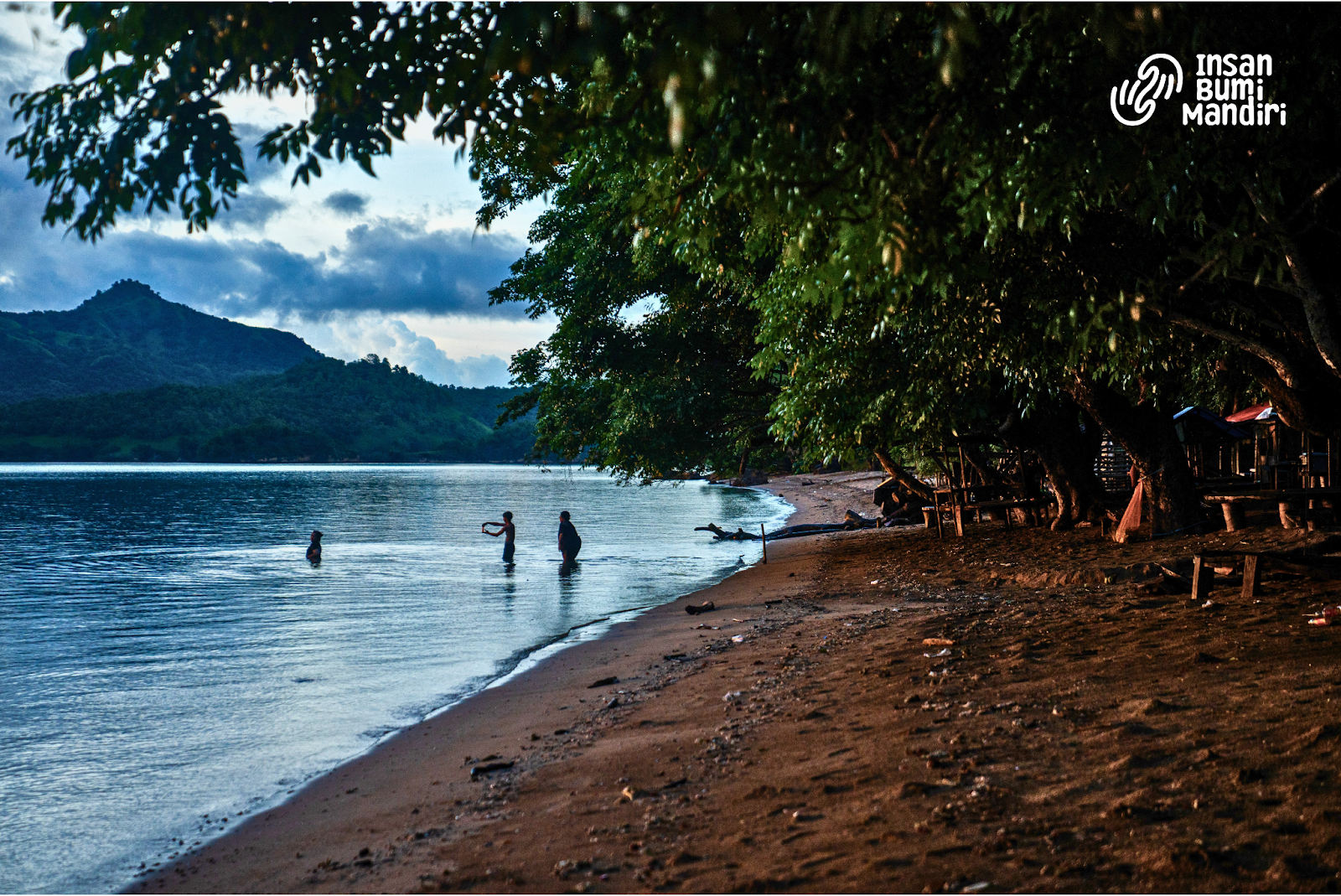
In the shadow of Labuan Bajo’s luxury resorts, a group of women from Kampung Soknar, Golo Mori, quietly build their livelihoods by the waves.
Finding the Hidden Beach
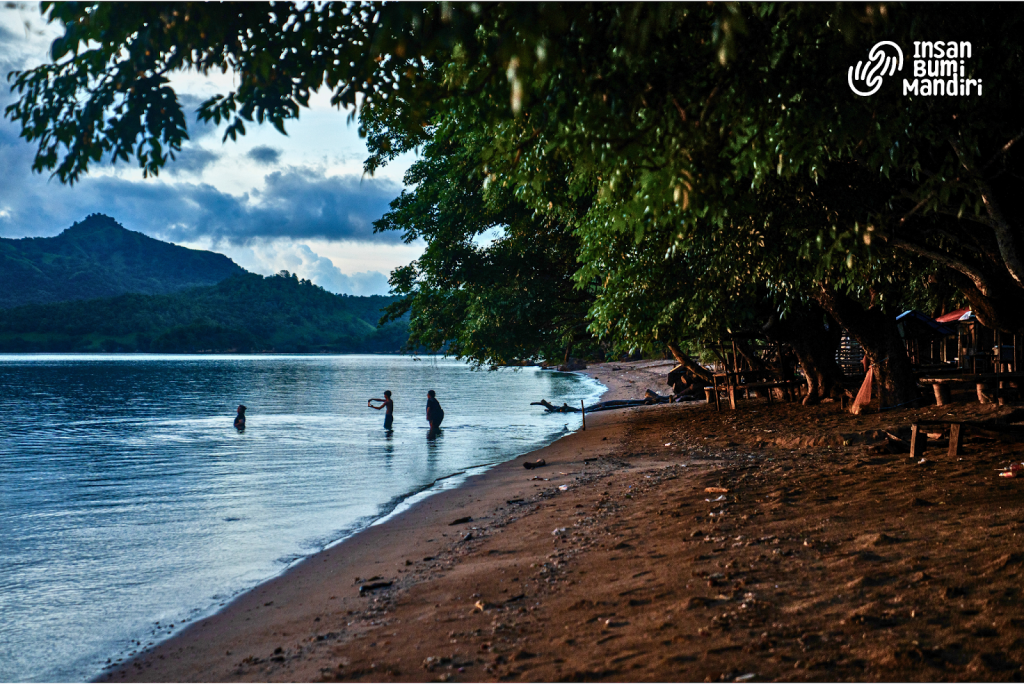
When our team first visited Pasir Panjang, even our driver had to ask twice for directions. There were no signboards, no entrance gates, and certainly no ticket booths. Only a narrow dirt road cutting through tall grass, leading to a quiet stretch of sand.
A foreign tourist stopped his motorbike nearby, holding his phone up to the sky in search of a signal. He did not realize that behind the trees, just a few meters away, lay one of the most beautiful beaches around Labuan Bajo.
Pasir Panjang is only about forty minutes from the town center, but it feels worlds away from the bustle of hotels and tourist boats. Over the years, most nearby beaches have been fenced off or turned into private resorts. Locals say it is now almost impossible to find a free beach. This one remains open not because it is managed, but because it has been almost forgotten.
The Women Behind the Market
During our visits to the village, we met around twenty women who run small, informal businesses. Every morning, around nine or ten, women from Soknar (a coastal area in Golo Mori village) walk nearly two kilometers under the 29 to 32-degree sun to reach the shore. They carry baskets filled with fish and small seafood catches from the night before. Some sell grilled fish, others offer coconuts and snacks.
There are a few buyers. Most days, they go home with almost all of their stock unsold. “Sometimes we just share what’s left among us,” said Sri, one of the women who comes almost every day. “It’s better than letting it spoil.”
Like many others, Sri is married to a fisherman. When the catch is small, she sells what little remains to help cover household needs.
When we first spoke with them, several women admitted they did not really know how to sell their products. “Everyone here sells the same things,” said Leni, another member. “When tourists pass by, we don’t know how to offer it to them. Sometimes we just write the price in the sand so they can understand.” They also shared their wish to learn how to process fish more effectively or improve their products so they could stand out and reach more buyers beyond the village.
Small Steps Toward Confidence and Change
Through the Glorious Golo Mori project, the women began joining a series of workshops focused on business skills and product development. They learned how to create simple fish-based products with guidance from a local chef, explored the importance of adding nutritional value to what they made, and discussed basic marketing strategies. Through the sessions, they also practiced using available local resources to develop new products and learned a few basic English phrases to help them communicate better with visitors. Many of them had never thought about these things before, branding, packaging, or even how to talk about their products with confidence.
Leni, a mother of three, said she used to think that business was only for people with higher education or capital. “Before, I thought we could never compete with those who have restaurants or shops in town,” she said. “But now, I understand that what we do also matters. We just need to learn how to make it better.”
When Courage Finds Its Voice in Golo Mori
A few weeks later, something remarkable happened. As part of the program’s activities, the women were invited to present their products at a small exhibition in Golo Mori. The event brought together representatives from the Maybank Foundation, the ASEAN Foundation, the Golo Mori Convention Center, hotel owners, and several local businesses.
For many of them, it was their first time stepping into what they called “a hotel.” They were amazed by the air conditioning, the polished floors, and the round tables covered with white cloths. Still, when their turn came, they stood proudly behind their displays, showing fish balls, dried anchovies, fish floss, and homemade chips.
Then we remember on the first day we met them, these same women could barely answer questions or make eye contact. During one workshop, not a single word came out when they were asked to speak in front of the group. But that day in the event, they stood before an audience of strangers and spoke about their products, the process, the flavor, and the hope that more people would learn about where it came from.
One of them, Nining, shared afterward, “I was so nervous, but I prepared together with my friends and with Ms. Anis, a youth volunteer from Malaysia. My products sold out, and some even asked for more. It was my first time visiting a hotel. It was so beautiful.”
It was not a grand success story, but for those of us who had seen them from the beginning, it was a profoundly moving moment. It showed how confidence can grow even in the most overlooked corners. They do not ask for charity or promises. What they seek is recognition, access, and the chance to be part of the progress happening around them.
These moments remind us why community-based programs matter. It begins with small steps, the courage to speak, to try, to show up. When we see them preparing their fish for the next day, we think back to that afternoon in the showcase event. Their voices were still soft but steady. For the first time, they were not just participants. They were speakers, business owners, and women who dared to be seen.
About the eMpowering Youths Across ASEAN (EYAA) Program
The eMpowering Youths Across ASEAN (EYAA) program is a collaboration between the ASEAN Foundation and the Maybank Foundation. Insan Bumi Mandiri (IBM) is one of ten civil society organizations (CSOs) across ASEAN selected to design and implement community-based initiatives under this program.
Through the Glorious Golo Mori project, EYAA supports local communities in Golo Mori, near Labuan Bajo, East Nusa Tenggara, Indonesia. The initiative brings together ASEAN youth volunteers who work with local partners to learn from the community, exchange knowledge, and contribute to sustainable social impact that extends beyond the program’s duration.
 English
 Afrikaans
 Albanian
 Amharic
 Arabic
 Armenian
 Azerbaijani
 Basque
 Belarusian
 Bengali
 Bosnian
 Bulgarian
 Catalan
 Cebuano
 Chichewa
 Chinese (Simplified)
 Chinese (Traditional)
 Corsican
 Croatian
 Czech
Czech Danish
 Dutch
Dutch Esperanto
 Estonian
 Filipino
 Finnish
 French
 Frisian
 Galician
 Georgian
 German
 Greek
Greek Gujarati
 Haitian Creole
 Hausa
Hausa Hawaiian
 Hebrew
 Hindi
Hindi Hmong
Hmong Hungarian
 Icelandic
 Igbo
Igbo Indonesian
 Irish
Irish Italian
 Japanese
 Javanese
 Kannada
 Kazakh
 Khmer
Khmer Korean
 Kurdish (Kurmanji)
 Kyrgyz
 Lao
Lao Latin
Latin Latvian
 Lithuanian
 Luxembourgish
 Macedonian
 Malagasy
 Malay
Malay Malayalam
 Maltese
 Maori
Maori Marathi
 Mongolian
 Myanmar (Burmese)
 Nepali
 Norwegian
 Pashto
 Persian
 Polish
 Portuguese
 Punjabi
 Romanian
 Russian
 Samoan
 Scottish Gaelic
 Serbian
 Sesotho
 Shona
Shona Sindhi
 Sinhala
 Slovak
 Slovenian
 Somali
 Spanish
 Sudanese
 Swahili
 Swedish
 Tajik
Tajik Tamil
Tamil Telugu
 Thai
Thai Turkish
 Ukrainian
 Urdu
Urdu Uzbek
Uzbek Vietnamese
 Welsh
Welsh Xhosa
Xhosa Yiddish
 Yoruba
 Zulu
Zulu